Chapter 1

The Narrator's Drawing

The cost of conformity to adult expectationsImagination and vision dismissed by practical thinkingThe loneliness of seeing what others cannot seeAdaptation as loss of self
This chapter has 3 parallels — tap the highlighted passages to explore them.

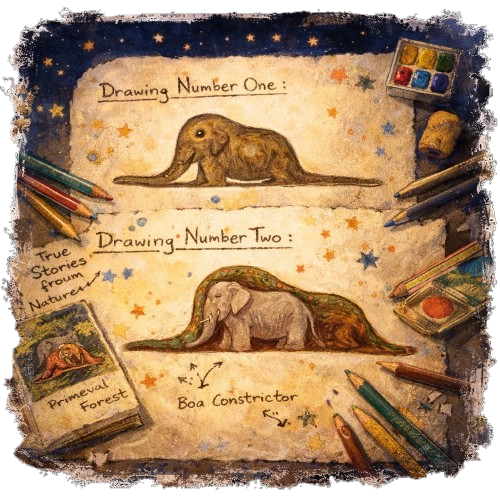
Chapter 1 illustrationOnce when I was six years old I saw a magnificent picture in a book, called True Stories from Nature, about the primeval forest. It was a picture of a boa constrictor in the act of swallowing an animal. Here is a copy of the drawing.

In the book it said: "Boa constrictors swallow their prey whole, without chewing it. After that they are not able to move, and they sleep through the six months that they need for digestion." I pondered deeply, then, over the adventures of the jungle. And after some work with a colored pencil I succeeded in making my first drawing. My Drawing Number One. It looked something like this:

I showed my masterpiece to the grown-ups, and asked them whether the drawing frightened them. But they answered: "Frighten? Why should any one be frightened by a hat?"

My drawing was not a picture of a hat. It was a picture of a boa constrictor digesting an elephant. But since the grown-ups were not able to understand it, I made another drawing: I drew the inside of a boa constrictor, so that the grown-ups could see it clearly. They always need to have things explained. My Drawing Number Two looked like this:

The grown-ups' response, this time, was to advise me to lay aside my drawings of boa constrictors, whether from the inside or the outside, and devote myself instead to geography, history, arithmetic, and grammar. That is why, at the age of six, I gave up what might have been a magnificent career as a painter. I had been disheartened by the failure of my Drawing Number One and my Drawing Number Two. Grown-ups never understand anything by themselves, and it is tiresome for children to be always and forever explaining things to them.

So then I chose another profession, and learned to pilot airplanes. I have flown a little over all parts of the world; and it is true that geography has been very useful to me. At a glance I can distinguish China from Arizona. If one gets lost in the night, such knowledge is valuable.

In the course of this life I have had a great many encounters with a great many people who have been concerned with matters of consequence. I have lived a great deal among grown-ups. I have seen them intimately, close at hand. And that hasn't much improved my opinion of them.

Whenever I met one of them who seemed to me at all clear-sighted, I tried the experiment of showing him my Drawing Number One, which I have always kept. I would try to find out, so, if this was a person of true understanding. But, whoever it was, he, or she, would always say: "That is a hat." Then I would never talk to that person about boa constrictors, or primeval forests, or stars. I would bring myself down to his level. I would talk to him about bridge, and golf, and politics, and neckties. And the grown-up would be greatly pleased to have met such a sensible man.

Parallel 1 ★
Show, don't tell: the medium you choose to communicate your vision fundamentally shapes whether it lands.
Mihika Kapoor
Mihika Kapoor Head of Product at Simile (ex-PM at Figma)
And so, I think a lot of folks when they think about visioning, they kind of think about, 'Okay, how do we start from scratch and learn about the user and then translate that into designs and then translate that into engineering?' And it becomes this very almost linear process... words will only get you so far. So, when I put together a vision with my team at Figma, it's all about not just your traditional, 'Okay, here are pain points. And then, here are solutions. And then, here is the timeline and costing.' But rather how can you bring all of those things together... simply describing a product idea in words is not as compelling as seeing a testimonial from a user on top of a prototype or a mock, and really feeling the pain points.
Why this parallel
The narrator's childhood struggle is precisely the problem Mihika Kapoor has spent her career solving: the gap between what a visionary sees and what an audience can perceive. The narrator's instinct to draw the inside of the boa constrictor — to make the invisible visible through a different form — is the same instinct that drives Kapoor to replace bullet points with prototypes and user testimonials. Both discover, through hard experience, that the medium of communication is not neutral; some truths can only be shown, never merely described.
Parallel 2
Examine which early setbacks still silently govern your decisions today—they're invisible until named.
Carole Robin
Carole Robin Co-Founder of Leaders in Tech; Former Stanford GSB Lecturer in Leadership
Because I never realized I was paying a cost for continuing to hold that belief that drove my behaviors. And mental models, then we developed them very early and they're grooved and we need new experiences in order to even believe that they're maybe subject to testing. Gee, I
Why this parallel
Carole Robin describes how a belief formed early in one's career becomes so deeply grooved that we stop perceiving the cost it extracts — it simply becomes the shape of the world. The narrator's childhood wound works exactly this way: a single early verdict from grown-ups hardens into a lifelong filter, and decades of adult encounters are processed through it rather than allowed to challenge it. Both texts illuminate the same quiet tragedy — not the original disappointment, but the unexamined loyalty to it.
Parallel 3 ★
Genuine curiosity about dissent beats dismissal; disagreement is data, not a character flaw.
Lenny Rachitsky
Lenny Rachitsky Writer of Lenny's Newsletter, host of Lenny's Podcast
It's easy to mentally write off a stakeholder who expresses concerns about your idea. You may think, 'They just don't get it.' This gets you nowhere. Invest the time to understand people's concerns and motivations. Ask open-ended questions to gain insights to create a compelling pitch.
Getting buy-in, Lenny's Newsletter, 2021-06-10
Why this parallel
The narrator's response to not being understood is to abandon his inner world entirely and mirror back what the grown-up wants to hear — a kind of hollow capitulation that purchases approval at the cost of authentic connection. The newsletter passage recognizes the same temptation and names its futility: writing off those who don't understand gets you nowhere. But where the narrator retreats into performance, the product wisdom pushes toward something harder — genuine curiosity about why the other person sees a hat, not a boa constrictor. The difference between the two is the difference between loneliness and collaboration.

The most expensive decision a product team ever makes is often one they don't remember making — a single early rejection that quietly became a roadmap principle, a hiring filter, a thing they stopped trying to show.

Chapters

Rediscover the book you loved — one chapter, one insight at a time.