Chapter 20

The Roses

the illusion of uniqueness through attachmentvalue defined by relationship, not comparisonthe painful gap between what we believe and what is trueresponsibility as the price of love
This chapter has 2 parallels — tap the highlighted passages to explore them.

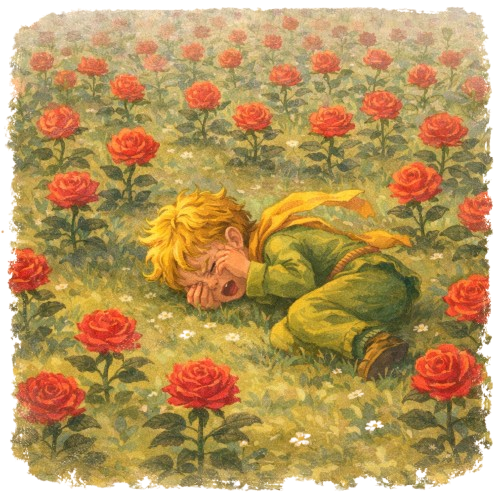
Chapter 20 illustrationBut it happened that after walking for a long time through sand, and rocks, and snow, the little prince at last came upon a road. And all roads lead to the abodes of men. "Good morning," he said. He was standing before a garden, all a-bloom with roses.

"Good morning," said the roses. The little prince gazed at them. They all looked like his flower. "Who are you?" he demanded, thunderstruck. "We are roses," the roses said. And he was overcome with sadness. His flower had told him that she was the only one of her kind in all the universe. And here were five thousand of them, all alike, in one single garden!

"She would be very much annoyed," he said to himself, "if she should see that . . . She would cough most dreadfully, and she would pretend that she was dying, to avoid being laughed at. And I should be obliged to pretend that I was nursing her back to life—for if I did not do that, to humble myself also, she would really allow herself to die. . ."

Then he went on with his reflections: "I thought that I was rich, with a flower that was unique in all the world; and all I had was a common rose. A common rose, and three volcanoes that come up to my knees— and one of them perhaps extinct forever . . . That doesn't make me a very great prince . . ." And he lay down in the grass and cried.


Parallel 1 ★
Your product vision will collide with market reality; use that collision to build something honest instead of defending what you imagined.
Eric Ries
Eric Ries Founder & Executive Chairman, Long-Term Stock Exchange (LTSE); Author of The Lean Startup
Building a startup is in large part a process of self-discovery. You actually are discovering what is true about the thing that you yourself believe. And partly that's because when we fantasize about the vision that we never have to make any trade-offs, the product is infinitely popular, infinitely cheap, everything's great.
Why this parallel
Eric Ries describes the gap between the founder's fantasized vision — frictionless, universally beloved, free of trade-offs — and the humbling reality the market eventually reveals. The little prince experiences exactly this: the flower he carried in his imagination was perfect and singular, but the world held five thousand just like her. Both the prince and the founder discover that the story they were living inside was a beautiful, necessary fiction — and that confronting its limits is not failure, but the beginning of something more honest.
Parallel 2
Abandon attachment to your creation's uniqueness and recommit to serving the actual need it solves for real people.
Keith Coleman & Jay Baxter
Keith Coleman & Jay Baxter Founding Community Notes ML Lead & Sr. Staff ML Engineer at X
For me, this project, I feel like I get to do community service with this project. I see my work as in service of the people and the community, and that's what motivates me. The only thing that I care about is delivering the outcome that the world finds helpful. So I think I feel more attached to the product being helpful than to anything else.
Why this parallel
The little prince understands, with quiet grief, that his devotion to his rose is not conditional on her being unique — it is the relationship itself, the tending and the responsibility, that gives his care its meaning. Keith Coleman arrives at the same place from a different direction: stripped of ego, title, and ownership, what remains is simply the desire for the thing to be genuinely useful. Both discover that the most durable form of commitment is not attachment to what you've built, but service to what it is meant to do for others.

The founder who discovers five thousand products just like theirs can collapse into grief — or understand, for the first time, that uniqueness was never the point; what keeps a product alive is not its rarity but the specific, irreplaceable relationship it builds with the people who depend on it.

Chapters

Rediscover the book you loved — one chapter, one insight at a time.