 It was now the eighth day since I had had my accident in the desert, and I had listened to the story of the merchant as I was drinking the last drop of my water supply. "Ah," I said to the little prince, "these memories of yours are very charming; but I have not yet succeeded in repairing my plane; I have nothing more to drink; and I, too, should be very happy if I could walk at my leisure toward a spring of fresh water!" "My friend the fox—" the little prince said to me. "My dear little man, this is no longer a matter that has anything to do with the fox!" "Why not?" "Because I am about to die of thirst . . ."
He did not follow my reasoning, and he answered me: "It is a good thing to have had a friend, even if one is about to die. I, for instance, am very glad to have had a fox as a friend . . ." "He has no way of guessing the danger," I said to myself. "He has never been either hungry or thirsty. A little sunshine is all he needs . . ."
But he looked at me steadily, and replied to my thought: "I am thirsty, too. Let us look for a well . . ." I made a gesture of weariness. It is absurd to look for a well, at random, in the immensity of the desert. But nevertheless we started walking. When we had trudged along for several hours, in silence, the darkness fell, and the stars began to come out. Thirst had made me a little feverish, and I looked at them as if I were in a dream. The little prince's last words came reeling back into my memory: "Then you are thirsty, too?" I demanded. But he did not reply to my question. He merely said to me: "Water may also be good for the heart . . ." I did not understand this answer, but I said nothing. I knew very well that it was impossible to cross- examine him.
He was tired. He sat down. I sat down beside him. And, after a little silence, he spoke again: "The stars are beautiful, because of a flower that cannot be seen."
I replied, "Yes, that is so." And, without saying anything more, I looked across the ridges of sand that were stretched out before us in the moonlight. "The desert is beautiful," the little prince added. And that was true. I have always loved the desert. One sits down on a desert sand dune, sees nothing, hears nothing. Yet through the silence something throbs, and gleams . . . "What makes the desert beautiful," said the little prince, "is that somewhere it hides a well . . ." I was astonished by a sudden understanding of that mysterious radiation of the sands. When I was a little boy I lived in an old house, and legend told us that a treasure was buried there. To be sure, no one had ever known how to find it; perhaps no one had ever even looked for it. But it cast an enchantment over that house. My home was hiding a secret in the depths of its heart . . .
"Yes," I said to the little prince. "The house, the stars, the desert—what gives them their beauty is something that is invisible!" "I am glad," he said, "that you agree with my fox."
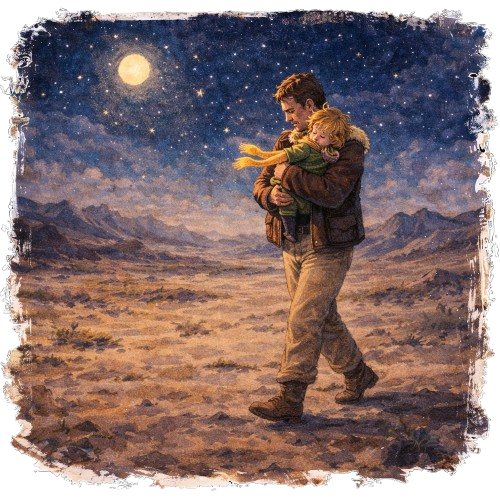
As the little prince dropped off to sleep, I took him in my arms and set out walking once more. I felt deeply moved, and stirred. It seemed to me that I was carrying a very fragile treasure. It seemed to me, even, that there was nothing more fragile on all Earth. In the moonlight I looked at his pale forehead, his closed eyes, his locks of hair that trembled in the wind, and I said to myself: "What I see here is nothing but a shell. What is most important is invisible . . ."
As his lips opened slightly with the suspicion of a half-smile, I said to myself, again: "What moves me so deeply, about this little prince who is sleeping here, is his loyalty to a flower—the image of a rose that shines through his whole being like the flame of a lamp, even when he is asleep . . ." And I felt him to be more fragile still. I felt the need of protecting him, as if he himself were a flame that might be extinguished by a little puff of wind . . . And, as I walked on so, I found the well, at daybreak.