Chapter 12

The Tippler

self-defeating cycles of shame and escapethe absurdity of rationalizationthe impossibility of helping those who won't face themselves
This chapter has 2 parallels — tap the highlighted passages to explore them.

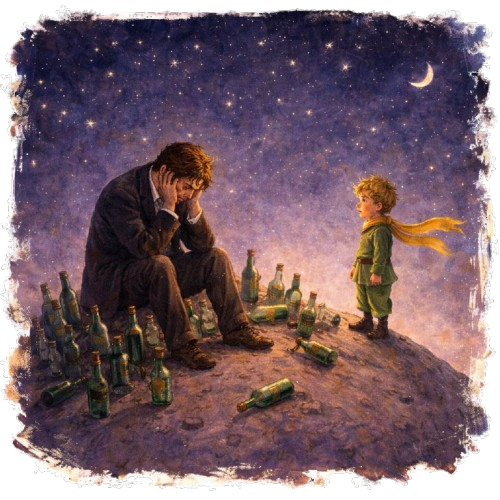
Chapter 12 illustrationThe next planet was inhabited by a tippler. This was a very short visit, but it plunged the little prince into deep dejection.

"What are you doing there?" he said to the tippler, whom he found settled down in silence before a collection of empty bottles and also a collection of full bottles.

"I am drinking," replied the tippler, with a lugubrious air. "Why are you drinking?" demanded the little prince. "So that I may forget," replied the tippler. "Forget what?" inquired the little prince, who already was sorry for him. "Forget that I am ashamed," the tippler confessed, hanging his head. "Ashamed of what?" insisted the little prince, who wanted to help him. "Ashamed of drinking!" The tippler brought his speech to an end, and shut himself up in an impregnable silence. And the little prince went away, puzzled. "The grown-ups are certainly very, very odd," he said to himself, as he continued on his journey.


Parallel 1
When users ignore their own needs, those needs don't vanish—they resurface as friction, complaints, and extreme behavior you must design around.
Lenny Rachitsky
Lenny Rachitsky Writer of Lenny's Newsletter, host of Lenny's Podcast
The parts that we judge, shame, or ignore actually tend to get louder and more extreme as we try to ignore them. The goal is to recognize each part as equally valuable, wise, and worthy of listening to.
Why no productivity hack will solve your overwhelm, Lenny's Newsletter, 2024-10-15
Why this parallel
The tippler is a man at war with himself — drinking to silence a part of him that is ashamed, which only amplifies the shame, which demands more drinking. The newsletter's insight that suppressed parts grow louder and more extreme is precisely the mechanics underneath the tippler's closed loop. What the little prince observes as odd adult behavior is, in the language of modern psychology, what happens when we refuse to validate our own inner conflict — the ignored part doesn't disappear, it simply takes over.
Parallel 2 ★
You cannot reason someone out of shame from the outside; create conditions where they feel safe enough to face it themselves.
Andy Johns
Andy Johns Mental health advocate and writer; formerly Venture Partner at Unusual Ventures, ex-Facebook/Twitter/Quora growth leader
What sits at the core of their suffering is not only a low sense of self, but a shame, a shame regarding who they are and who they believe themselves to be.
Why this parallel
Andy Johns describes the same impregnable wall the little prince encountered — shame so foundational that it cannot be reached from the outside, only circled. The little prince's puzzlement is the exact experience Johns is describing: the genuine desire to help colliding with the reality that shame, until it becomes intolerable enough to seek truth, makes a person unreachable. Both texts understand that the locked door isn't stubbornness — it's the architecture of suffering itself.

The users who churn without a word, who ghost your surveys and skip your check-ins — they are not indifferent; they are ashamed of needing something you never made them feel safe enough to ask for. The product that creates no space for honest failure will always be puzzled by its own abandonment.

Chapters

Rediscover the book you loved — one chapter, one insight at a time.