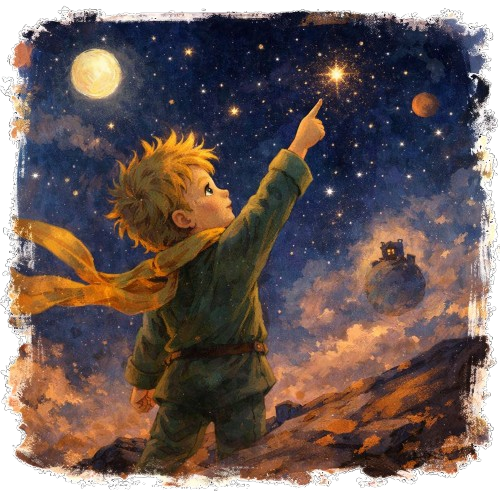
Chapter 3

From Another Planet

The futility of control through constraintPerspective blindness—seeing through our own scaleThe gap between practical worry and actual consequenceOwnership as burden disguised as care
This chapter has 2 parallels — tap the highlighted passages to explore them.

Chapter 3 illustrationIt took me a long time to learn where he came from. The little prince, who asked me so many questions, never seemed to hear the ones I asked him. It was from words dropped by chance that, little by little, everything was revealed to me.

The first time he saw my airplane, for instance (I shall not draw my airplane; that would be much too complicated for me), he asked me: "What is that object?" "That is not an object. It flies. It is an airplane. It is my airplane." And I was proud to have him learn that I could fly. He cried out, then: "What! You dropped down from the sky?" "Yes," I answered, modestly. "Oh! That is funny!" And the little prince broke into a lovely peal of laughter, which irritated me very much. I like my misfortunes to be taken seriously.

Then he added: "So you, too, come from the sky! Which is your planet?" At that moment I caught a gleam of light in the impenetrable mystery of his presence; and I demanded, abruptly: "Do you come from another planet?" But he did not reply. He tossed his head gently, without taking his eyes from my plane: "It is true that on that you can't have come from very far away . . ." And he sank into a reverie, which lasted a long time. Then, taking my sheep out of his pocket, he buried himself in the contemplation of his treasure.

You can imagine how my curiosity was aroused by this half-confidence about the "other planets." I made a great effort, therefore, to find out more on this subject. "My little man, where do you come from? What is this 'where I live,' of which you speak? Where do you want to take your sheep?" After a reflective silence he answered:

"The thing that is so good about the box you have given me is that at night he can use it as his house." "That is so. And if you are good I will give you a string, too, so that you can tie him during the day, and a post to tie him to." But the little prince seemed shocked by this offer: "Tie him! What a queer idea!" "But if you don't tie him," I said, "he will wander off somewhere, and get lost." My friend broke into another peal of laughter: "But where do you think he would go?" "Anywhere. Straight ahead of him." Then the little prince said, earnestly: "That doesn't matter. Where I live, everything is so small!" And, with perhaps a hint of sadness, he added: "Straight ahead of him, nobody can go very far . . ."


Parallel 1 ★
Build constraints into your product design, not your culture deck—the system itself should enforce what matters.
Dharmesh Shah
Dharmesh Shah Co-founder and CTO at HubSpot
So the lesson I would carry away is come up with systematic ways and mechanisms, as Amazon would call them, of putting guardrails and constraints in to the degree that you can. Because you can put words on a page and try to infuse it in the culture, it's like, "Oh, we believe in simplicity, we fight for this," and you can have meetings and you can get up in all-hands meetings and reinforce that, which I encourage you to do, but a really, even a reasonably well done system will outbeat any other mechanism that you can try to
Why this parallel
The narrator's instinct to tie the sheep — to impose control through explicit restraint — is the same anxious impulse Dharmesh Shah identifies in companies that try to preserve simplicity through culture decks and all-hands speeches. Both mistake the performance of constraint for the thing itself. What Dharmesh discovers through decades of building, the little prince already knows by laughing: on a world small enough, the system itself is the guardrail, and the rope is unnecessary theater.
Parallel 2
Start from customer value and work backward; beginning from business metrics sends you the wrong direction entirely.
Bill Carr
Bill Carr Co-founder of Working Backwards LLC; author of Working Backwards; former VP at Amazon
... Jeff would say, we took it as an article of faith. If we served customers well, if we prioritized customers and delivered for them, things like sales, things like revenue and active customers and things like the share price and free cash flow would follow. So therefore, when we're making a decision thinking about a problem, we're going to start with what's best for the customer and then come backward from there.
Why this parallel
When the little prince hears the narrator flew in from the sky, he does not marvel at the machine or the distance — he simply recalibrates his understanding of what matters, then returns to contemplating his sheep. Bill Carr describes the same reorientation at Amazon: rather than starting from financial constraints and working forward, Amazon began from the customer and worked backward, trusting that everything else would follow. Both the little prince and Bezos's team understood that beginning from the wrong scale — from the airplane, from the revenue target — sends you in the wrong direction entirely. The treasure was never the machine.

The most seductive roadmaps are built like tethering posts — elaborate systems to prevent the sheep from wandering — when the real question, the one that laughs at you if you miss it, is whether you understood your world well enough that the sheep had nowhere to go but home.

Chapters

Rediscover the book you loved — one chapter, one insight at a time.